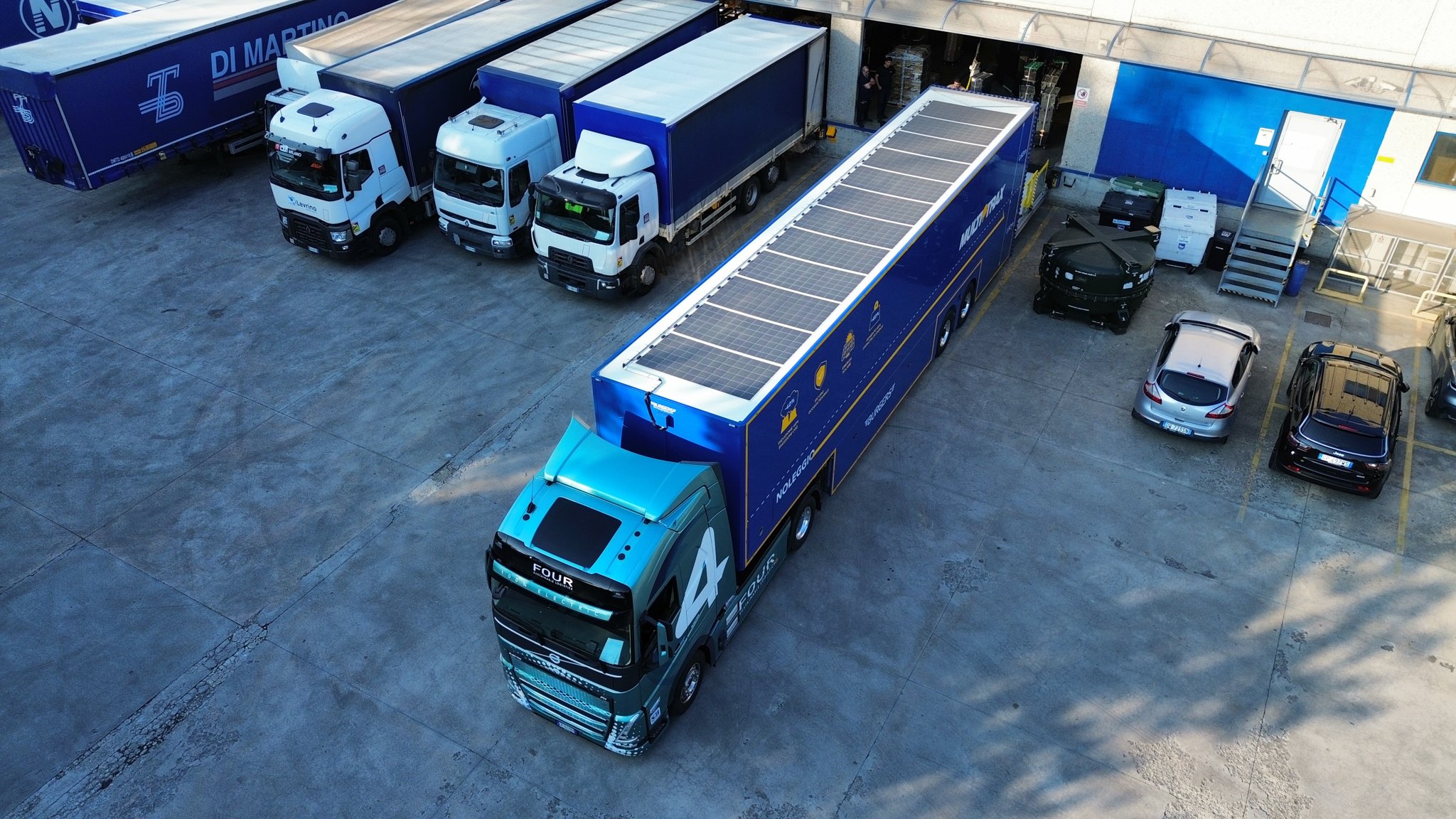
Hanover, Germany, September 14, 2026. Royal Burgers and Emons Group reveal more about the technology behind the new generation of Double Deck. The trailer was jointly developed by both companies and represents a further evolution of an already successful high-volume FTL concept. This specific application is designed for efficient warehouse-to-warehouse transport. The existing Double Deck operation transports 52 Euro pallets or 40 UK pallets with load heights ranging from 130 to 180 centimeters. The existing concept is already robust. The new generation makes it even better.
The new generation of Double Deck trucks combines a flexible hydraulic floor system, a new Smart Steering System, and a body design engineered to maximize usable cargo space. Royal Burgers brings specialized expertise in engineering and manufacturing, while Emons contributes extensive operational and commercial experience gained from daily high-volume FTL transport. This partnership is an innovation that combines the best of both worlds.
The loading process begins with the hydraulically adjustable floor in the lowered center section—the “belly”—of the trailer. The floor is first raised to the same height as the warehouse dock, so that the first 18 pallets can be loaded immediately. The entire floor, including the load, then lowers to the “belly” position. Because the hydraulic drive is integrated into the trailer walls, the mechanism does not reduce the usable loading width.
The short rear lift then makes controlled vertical movements between dock level and the upper loading deck. Through these repeated short movements, 28 pallets are transported from the dock to the upper deck. Once these pallets are loaded, the lift returns to floor level and dock level. The last 6 pallets are then loaded directly onto the rear section of the loading deck; the lift does not move during this final step. This results in a total loading configuration of 18 + 28 + 6 = 52 pallets.
The middle deck can also be moved to provide a continuous interior height of up to 2.50 meters. In this configuration, the trailer can accommodate up to 33 conventional pallet spaces. This feature is intended to optimize routing for suitable return loads. In this way, carriers reduce empty mileage, lower transportation costs, and improve their sustainability, while high-volume double-deck transport remains the trailer’s primary application.
Another important development is the new electronically-hydraulic Adaptive Steering System. Conventional mechanical steering requires a relatively large and heavy linkage assembly in the coupling plate to transmit steering forces to the rear axle. The new system uses yaw rate sensors and direction-dependent speed sensors to determine the articulation angle between the tractor and the trailer and to calculate the required steering angle of the rear axle. The steering force is provided by electrohydraulic power packs. This change saves approximately half a metric ton, primarily in the coupling plate, and allows for a flatter coupling plate. This is an important requirement for double-deck trailers. The mechanical decoupling reduces lateral forces and tire wear on the tractor, which indirectly contributes to the emission reductions required by Euro 7. At higher speeds, the rear axle is held in a straight position, which improves the driving stability of the entire combination.
The result is more than just a technical advancement. It is a trailer concept that efficiently integrates with real-world logistics processes, QHES and compliance requirements, loading docks, and warehouse operations, while also improving fleet utilization and transportation efficiency.
The new generation of Double Deck trailers is designed for transport by road, rail, and short-sea. Thanks to the integrated Inner Lift System, the trailer can also be used in EcoCombi and Super-EcoCombi configurations (EMS2), which further increases flexibility within various logistics networks.
Through this partnership, Royal Burgers and Emons Group are combining the best of both worlds: specialized trailer engineering and proven practical experience. The new generation takes a tried-and-true Double Deck concept a step further, based on a single principle: building the trailer around the operation, rather than adapting the operation to the trailer.
Royal Burgers refers to the trailer as " Dock to Dock," while Emons refers to it within its own operations as the new generation 2WIN. Both names refer to the same, jointly developed trailer solution.
Royal Burgers and Emons will present the new generation of Double Deck at IAA Transportation 2026 in Hanover, from September 15 through 20, at the Royal Burgers booth in Hall 27, Booth F38, and at outdoor area S33.